
The Matching Moment: Why Wearing the Same Trunks as Your Son Matters More Than You Think
- by Shopify API
It starts before you get to the beach. Seven in the morning, the house still cool, and a small person appears in your doorway holding the same pair of trunks you're about to reach for. He grins. You grin. Neither of you says anything. That's the whole thing.
I've watched it happen a hundred times with Syd and Rex. The small, deliberate pride of a boy pulling on the same trunks his dad is wearing. Not because anyone told him to. Because matching, for a child, is a way of saying something they don't have the vocabulary for yet. Something along the lines of: I want to be where you are. I want to be like you. Today, we're the same.
It's a tiny moment. It takes about thirty seconds. It carries more weight than most people realise.
Mornings in our house, in summer, follow a pattern. Breakfast is negotiated. Sun cream is applied under protest. Someone can't find a sandal. Then there's the moment when you both reach for your trunks, and the day properly starts.
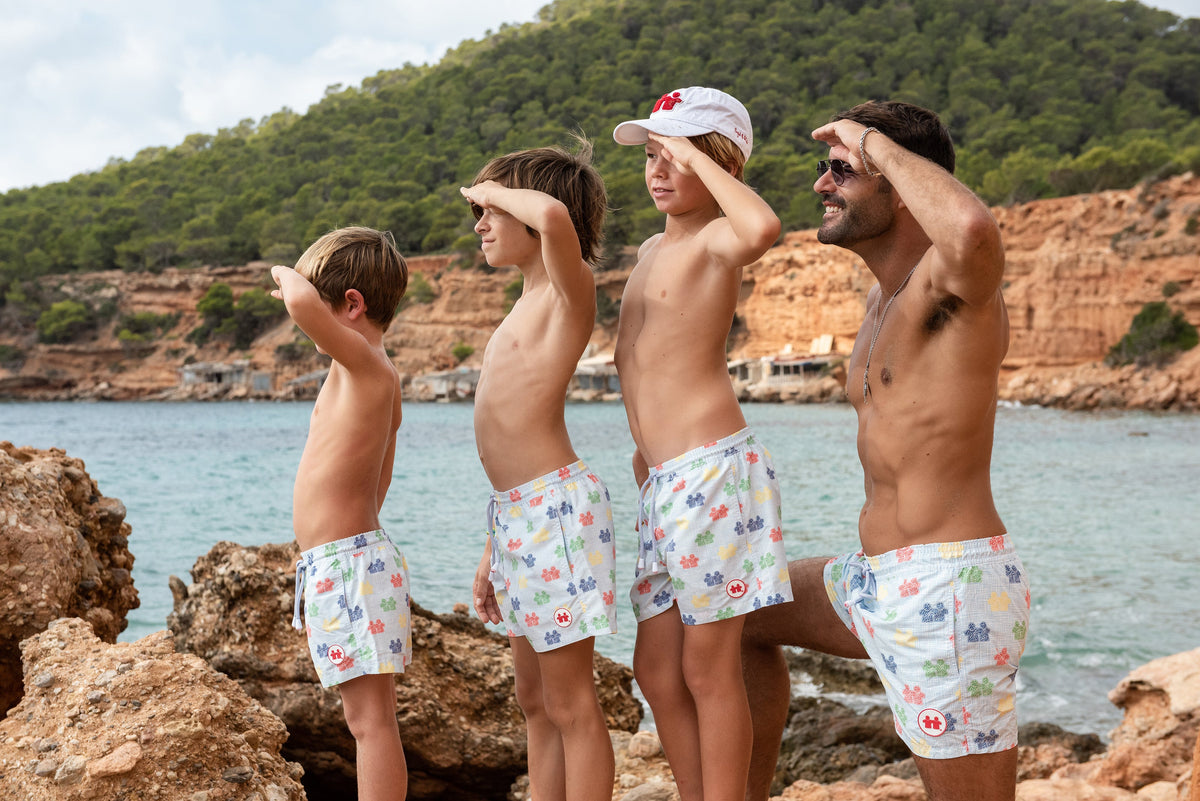
When the trunks match, something shifts in the energy. The boys stand taller. There's a quiet strut on the walk to the car, like they've been let into something. They're not just going to the beach. They're going with their dad, in the same gear, as part of the same team.
It sounds like a small thing because it is a small thing. But fatherhood, the real version, the one that happens between the birthday parties and the parents' evenings, is built entirely on small things. The walk to school where they hold your hand without being asked. The moment in the car when they tell you something they haven't told anyone else. The look they give you when they've done something brave and need to check that you saw it.
Matching trunks is one of those small things. A daily, wearable reminder that you belong to each other.
There's a specific expression a boy makes when he looks down and sees that his trunks match his father's. I've seen it on my two, and I've seen it at beaches across the island on other people's children.
It's not excitement, exactly. It's more like satisfaction. A six-year-old's version of confidence. Like he's solved something. Like the outfit is proof that the relationship is real, that the connection isn't just something adults talk about but something you can see and touch and wear to the beach.
Children process belonging through tangible things. A shared secret, a private joke, a pair of matching trunks. These are the building blocks of identity. Before they're old enough to understand abstractions like love and loyalty, they understand sameness. We have the same ones.
If you've ever seen that look, the one where the small face lights up because the trunks match, you don't need me to explain why we make them in matching pairs. If you haven't seen it yet, you're in for something.
This isn't a fashion play. Matching father-son outfits can go very wrong very quickly. Forced coordination, Instagram-posed twinning, the kind of "mini-me" content that makes everyone slightly uncomfortable. That's not this.
What works is accidental matching. Or better, deliberate but unspoken matching. You both reach for the same print because you both like it. No staging. No announcement. Just two people in the same household who happen to have good taste and the same morning routine.
The psychology is straightforward. Shared clothing creates a sense of belonging. It's the same principle behind team uniforms, but without the coach's whistle and the 6 a.m. fitness session. When a father and son wear the same trunks, they signal to each other, and to the world, that they're a unit. A team. Together on purpose.
For the boy, it's affirmation. He's not just tagging along to the beach. He's part of something.
For the father, it's a reminder. Of why you do all of it. The job, the commute, the mortgage, the quiet worry. You do it for the person currently racing you to the water in the same trunks, shrieking because the sea is cold and laughing because it doesn't matter.
Here's what nobody tells you about fatherhood and time: the summers don't feel like they're accumulating while they're happening. Each one feels like its own thing, a self-contained block of heat and sand and ice cream. But they stack. Silently, invisibly, they build into something.
Syd was maybe four the first time we matched trunks. He's older now, and the trunks are different sizes, but the ritual is the same. The morning reach. The grin. The walk to the beach where we're the same team we were when he was small enough to ride on my shoulders.
Rex, being younger, inherited both the trunks and the ritual. By the time he was old enough to notice, matching was just what we did. It wasn't a thing. It was how things were.
That's the goal, really. Not to create a moment that feels special and manufactured and photographable. To create one that feels normal. Because the rituals that shape a childhood aren't the big ones, the holidays, the birthdays, the milestones. They're the ones that repeat so often they stop feeling like rituals and start feeling like identity.
"We always match our trunks." That's not a marketing line. That's a family tradition, and it started the way all good traditions start: by accident, then by choice, then by instinct.
People sometimes ask me why I named a brand after my sons. Isn't that a lot of pressure? What if they don't like swim trunks? What if they go through a phase where they want nothing to do with their dad's company?
The honest answer is that I didn't name the brand after them strategically. I named it after them because the feeling I was trying to capture, the whole "let your shoulders drop" philosophy, lives most naturally in the relationship between a father and his kids at the beach.
That feeling. The morning trunks. The race to the water. The moment you look down and your son is wearing the same ones. That's Syd & Rex. Not the company. The feeling the company is trying to preserve.
Many of the trunks we make comes in men's and boys'. Same print. Same fabric. Same SeaQual ocean plastic yarn. Same care in the cut. The only difference is the size, because everything else about the moment should feel exactly the same.
Some fathers buy the set and match immediately. Some buy for themselves first, then get the boys' pair when the son spots them and says, "Can I have the same ones?" Both routes end the same way: at the water's edge, matching, grinning, and racing.
That's the whole thing. That's what we named the brand for.
We made a playlist for this one. Acoustic, warm, unhurried. The kind of music that plays in the background of the summers you'll remember. Search "Father & Son - Syd & Rex" on Spotify.
The Father & Son Edit is a regular column in The Journal. Matching moments, family rituals, and the reason we make every print in men's and boys'. Personal, honest, no saccharine.
Share:
What to Wear in Ibiza: The Local's Guide
What We Mean When We Say Brotherhood